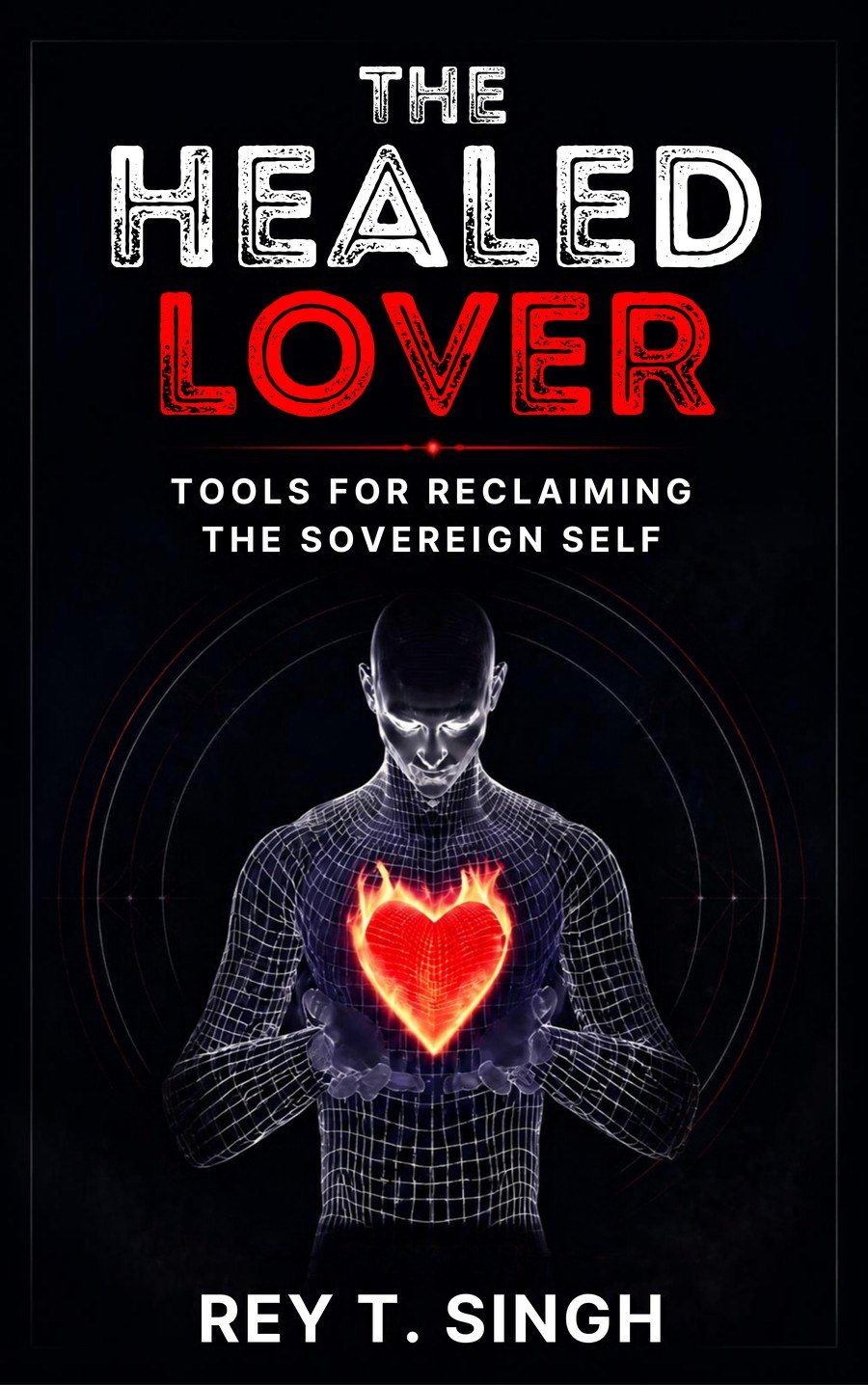
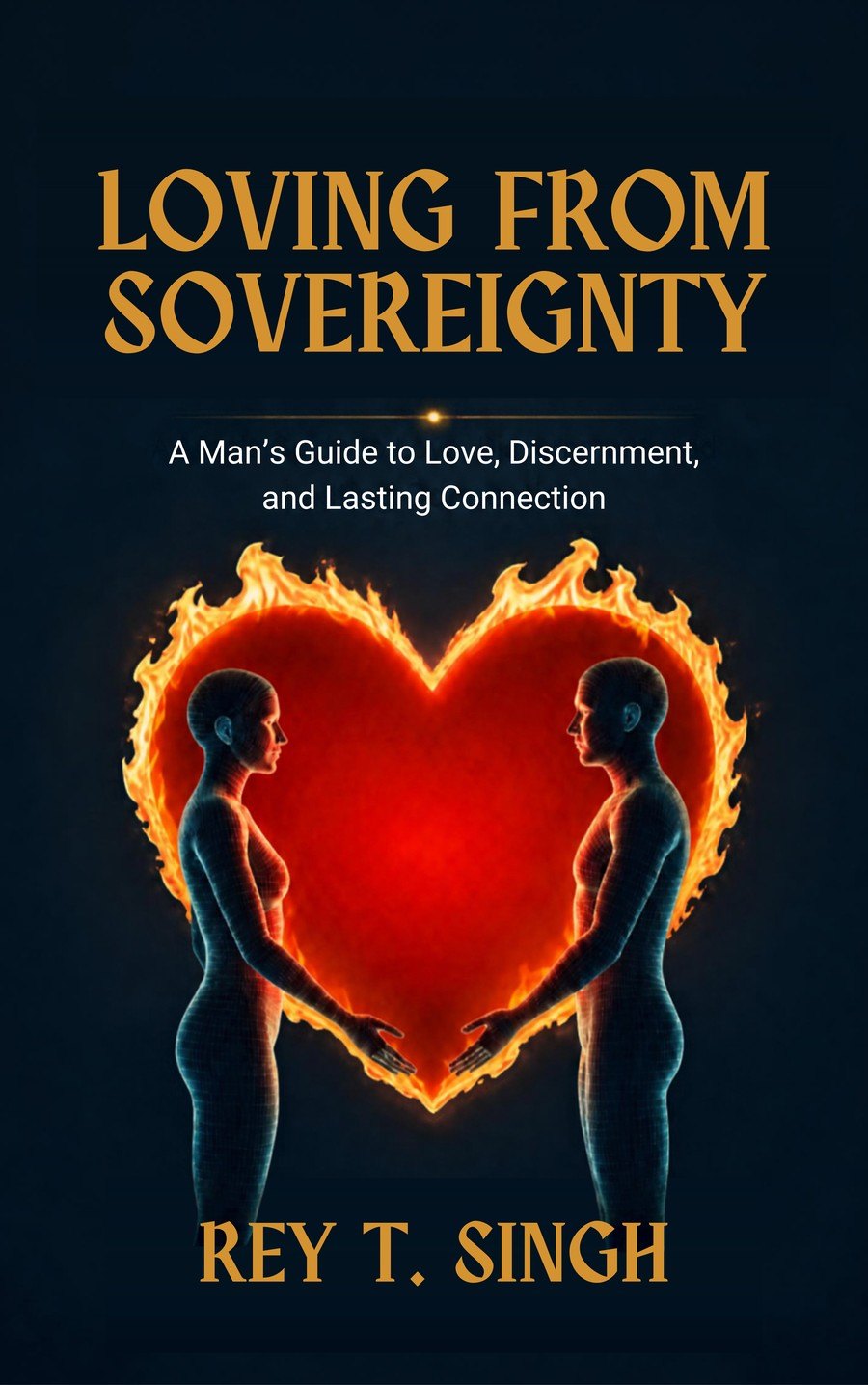
Cover of The Healed Lover: Tools for Reclaiming the Sovereign Self, by Rey T. Singh Cover of Loving from Sovereignty: A Man’s Guide to Love, Discernment, and Lasting Connection, by Rey T. Singh

You don’t have to abandon yourself to be loved.

Rooted in the body. Grounded in science. Open to Spirit.

Practical, body-first tools for men carrying old hurt: learn to steady yourself under stress, understand why the same patterns keep repeating, and bring a clearer sense of your worth and your boundaries into the relationships that matter to you.

By Rey T. Singh, Registered Social Worker, Psychotherapist. Both books arrive Tuesday, November 24, 2026, in paperback; ebook and audiobook to follow.

A word from the author

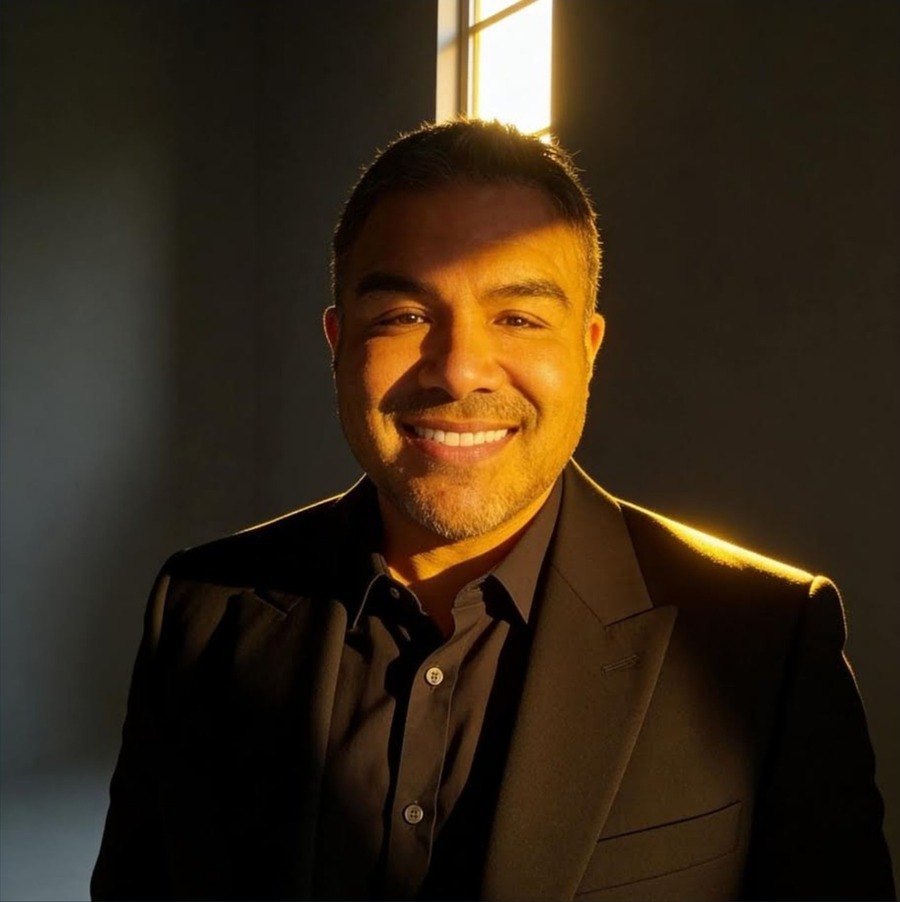
A short introduction to both books, in an AI-generated video of the author (1:17).

The path both books walk

Sovereignty is reclaiming the parts of yourself you didn’t know were yours — and it happens in good company.

Both books walk one road, and it starts in the body. Book One moves through five parts: catching your breath, finding your feet, understanding why it hurt, stepping back into the world, and building something that lasts. Book Two turns outward, because sovereignty isn’t meant to be a fortress: the steadier you are in yourself, the more room you have to let people in. Across both, the aim is to move past old wounds rather than keep living from them: to love from your wholeness, not your wound. This work happens in good company, with the people who mirror you back to yourself, the lineage you come from and, if it is your language, Spirit, by whatever name you know it.

The vision

Many men were taught to perform, provide and endure, and to leave their own needs unseen — and fewer were shown how to feel, how to steady themselves, or how to build love from wholeness instead of fear. The Healed Lover™ series is a gentle call to action: it gives men words to name these parts of their lives, and practical tools to tend them.

Body first

Your body is where the way back begins. Learning to listen to it, and to hear the difference between an old wound’s voice and the voice of your whole self, is the first skill these books teach. Every chapter turns knowledge into something you can feel: breath, grounding, noticing where you brace, steadying yourself before you speak or choose.

Grounded in science

The practices are grounded in research on how the nervous system, emotion and attachment work, from polyvagal and attachment science to the study of feelings and the body’s signals, with the sources cited in both books. Close to two decades of clinical practice stand behind them.

Open to Spirit

Many cultures and faiths teach a person to see their life from a wider place: a vision from Spirit. The books invite you to reclaim that vision, in your own tradition or in none, and put it to work on your road to health. Reconnecting with your lineage, and with the spiritual understanding of the people you come from, can be a deep source of resilience, one that may open pathways to healing and restoration.

Many ways to the centre

Most models of health name the body, the mind and our relationships; few name lineage. These books advocate no religion. They map the parts of a whole life that many of us may not have been taught to tend, the lost domains, and show how reconnecting with them can support our return to health and to our own sovereignty: the body, what we feel and how we voice it, the people around us, and the lineage we come from, with the purpose and worldview it carries. Many of these resources are closer than they seem; often what was lost was the connection to them.

What that reconnection looks like is different for every reader. The architecture is the same: body-first practices grounded in nervous-system science, with room for your own spiritual roots, or none. Faiths, cultures, families and lineages each carry their own way to the centre; The Healed Lover™ series is one blueprint among them.

This is education and skill-building, not therapy. No belief required, no diagnosis: clear knowledge, practical skills, and a ritual that becomes your own.

The lost domains of wellness

The Garden of the Self

Some of what makes a life whole was nurtured early and well. Some was trampled before it could take root, and some was never tended at all, because no one around us knew how. What was never tended doesn’t disappear; it goes dormant. And some has grown out of balance, crowding out the rest. Loving from Sovereignty maps seven lost domains of wellness: what each one needs to grow, and who might help it grow, because every domain grows in good company. You don’t need a green thumb. If you’ve kept a lawn alive, trained for a season or raised a child, you already know how growth works.

Rootedness

Below · felt at the root

Feeling safe in your own body and knowing where you come from: the story of your bloodline, what it came through, and the strength that carried it.

Grows with your feet on the ground, time on the land, and learning your own story: researching your family’s history, sitting with elders and older kin, mending lost connections as far as you’re able, and naming what pressed on your line, from colonization and capitalism to everyday racism.

Feeling

The emotional life · felt in the belly

Feeling the full range of what is in you, naming it, and letting it move, with room for joy, play and creativity.

Grows with naming what you feel, music, play, and grief that is allowed to finish, beside friends who can hear a feeling without rushing to fix it.

Vitality

The physical life · felt at the solar plexus

Tending your body, steadying your nervous system, and keeping your energy as your own.

Grows with movement, sleep, food prepared with care, beside people who move: a team, a walking group, a shed full of men working shoulder to shoulder.

Self-reflection

Within · felt at the heart · the centre of the garden

Turning inward honestly and kindly, and meeting your own pain with the compassion you would offer a friend.

Grows with daily stillness, journaling, prayer or meditation in your own tradition, a hand on your heart, and circles where honesty is the custom.

Voice

The mind · felt in the throat

Putting your inner world into words: speaking the truth kindly, and listening as well as you speak.

Grows with writing, reading, and saying one true thing each day, beside friends who can disagree without contempt.

Insight

The spiritual life · felt at the brow

Seeing beneath the surface, through intuition, perspective, and the pattern recognition that turns repetition into choice.

Grows with contemplative practice, time in nature, and the slow reading of wisdom in your own tradition, beside mentors a little further along the road.

Connection

Above · felt at the crown

Staying connected to something larger than yourself (Creator, Spirit, purpose, the generations to come), and letting it give your life direction.

Grows with prayer or meditation, solitude long enough for vision to arrive, service shared with others, and mentoring someone younger.

A reflection, not a diagnosis; nothing you choose is saved or sent. The map is Rey’s own synthesis, laying the Seven Directions, which he holds as a guest of the teaching rather than its owner, over the seven centres of the body. It draws on two traditions he honours, and it does not claim they teach the same thing. From Loving from Sovereignty, Chapter Six.

What sets these books apart

Tools for the hardest minute

Short, body-based practices you can use at 2 a.m., in the truck, or in the second before you text back. Not theory to admire: steps you can take. In a hard moment, wholeness starts in the body and in the parts of you still standing: the ground under your feet, the people and the line behind you, and whatever you know as Spirit.

Honest, not performative

Rey tells on himself — his own mistakes, his own way home — so you don’t have to pretend to be further along than you are.

“The voice is honest, not performative.”— Jodi Desmoulin

No blame, on either side

Not a book that shames men, and not one that blames women. It hands each person their own healing, and the dignity of doing it.

A clinical spine, with room for Spirit

Grounded in how the nervous system and attachment actually work, and open to faith, ceremony and lineage — in your own tradition, or in none. For therapists and counsellors, a clinical companion at the back of each book follows the same stages, chapter by chapter.

“An integrative guide to healing and relationships.”— Stephen W. Porges, PhD

More than a breakup book

Written for the man after a relationship ends, it also meets fathers, partners, widowers and men starting over — and the people who love them.

“Ultimately, this book is not only for men.”— Rose Kristmansson

You feel it at home

The change shows up where it counts: in how you listen, how you speak, and how you stay present with the people you love.

“My wife noticed a change in how I communicate with her.”— Randy Laybourne

Wherever you are standing

Every reader arrives from somewhere. Choose where you are right now, and see where to begin.

Just starting out

You’re early, and early is a gift. Learn your body’s signals and tell attraction from alarm while your patterns are still taking shape.

Start with Book One.

Single

Not a waiting room. A season to come to know the man you’d bring to any love, and to build an inner home that’s yours, whoever later walks through the door.

Start with Book One.

Dating

The early weeks set more than either of you can see. Slow down, read your own signals, and let trust grow at the pace of safety.

Begin with Book Two. It stands on its own, and Book One deepens it.

Partnered

You don’t have to be planning an exit to belong here. Much of this work can begin inside a relationship, and some of it can only be done there.

Start with Book One, then Book Two.

Separated or divorced

Grieve without collapsing, own whatever part is yours without drowning in it, and, if there are children, become the steady one they can lean on.

Start with Book One.

Widowed

Nothing here will hurry your grief. If you come to love again, you won’t have to set the first love aside. A heart can hold both.

Start with Book One, and turn to Book Two when you’re ready.

Later in life

Sovereignty isn’t only for the young. Come home to yourself, make your peace, and love the people in front of you with a more open heart.

Begin with either book: Book One or Book Two.

These books welcome every reader: men and women, every culture and faith, and every way of loving.

Try one minute now

Every chapter ends in the body. Here is a taste: one minute of slower breathing. Sit back, let your feet find the floor, and follow the light: in as it grows, out as it settles.

Go gently, and stop whenever you like.

Two books, one road

Book One brings you home to yourself. Book Two shows you how to love someone else without leaving that home.

Every chapter gives you:

  • Essential knowledge in plain language: how your body reacts under stress, and why old patterns keep repeating
  • A body-based practice you can use in the moment
  • Reflections that help you see your own story clearly
  • A closing practice that becomes a daily ritual of your own

Book One

The Healed Lover™

Tools for Reclaiming the Sovereign Self

You can’t be loved where you don’t live. Enough isn’t something you earn. It’s a body you come home to.

The Healed Lover™ is not a book about finding the right person. It is a blueprint and a toolkit for the relationship the others stand on: the one you have with yourself.

Explore Book One

Book Two

Loving from Sovereignty

A Man’s Guide to Love, Discernment, and Lasting Connection

You did the work. You came home to yourself. Now — how do you love someone else without losing the ground you fought for?

Loving from Sovereignty is not about being chosen. It is about choosing well — from wholeness, not from hunger.

Explore Book Two

“Rey T. Singh has created an integrative guide to healing and relationships that thoughtfully incorporates Polyvagal Theory within a broader trauma-informed and relational framework. His compassionate approach offers readers practical tools for cultivating self-awareness, resilience, and authentic connection.”

— Stephen W. Porges, PhD, creator of the Polyvagal Theory

“Authentic healing begins when you allow yourself to be vulnerable emotionally, mentally, physically, and spiritually. If healing were easy, everyone would do it. When healing, do your 50%, and Creator will help with the other 50%. These books show you how to do your 50%.”

— Gerald Auger, Woodland Cree, Ceremonialist

“Through Filipino Martial Arts, I’ve come to appreciate that personal growth extends far beyond physical skill. The practice teaches us self-awareness, resilience, and the importance of staying connected to our roots. Rey T. Singh’s work encourages men to reflect on their experiences, reconnect with themselves, and approach healing, personal growth, and relationships with greater awareness, understanding, and a stronger sense of self.”

— JB Ramos, Owner & Lead Instructor, Combat Science: Warrior Arts of Asia

“I have been looking for something that would help couples in their relationships … So as I read Rey’s works I found what I was looking for. I found it covered all four areas of healing [physical, emotional, mental, and spiritual]. I strongly recommend these books for a whole healing approach to self-healing.”

— Jim Rankin, senior counsellor for 24 years at a Native youth treatment centre; addiction counsellor for 45 years

“From a Two-Eyed Seeing perspective, The Healed Lover succeeds in bringing together evidence-based knowledge and deeper human truths about connection, meaning, and healing.”

“Ultimately, this book is not only for men. It is for anyone seeking to better understand themselves, heal old wounds, and return to a place of balance, authenticity, and personal sovereignty.”

— Rose Kristmansson, Ts’msyen Future Educator

“I found the book helpful. Even as I was going through it, my wife noticed a change in how I communicate with her. I think this book would benefit anyone.”

— Randy Laybourne

“The voice is honest, not performative. You don’t hide behind the clinician role. … It didn’t feel like blaming women. … Overall, this is a needed book. It doesn’t pretend to have healed everything, it offers a return.”

— Jodi Desmoulin

Questions you might be asking

Why do I keep ending up in the same kind of relationship?

Book One explains how an early template of love can steer attraction, and how to notice that pull in your body before it chooses for you. Book Two carries it into dating, as discernment.

I can’t stop thinking about them. Why is it so hard to let go?

Bonds live in the body, and the body can grieve them hard. Book One explains why, and offers short practices for the hardest moments.

Why do I shut down, or blow up, when things get heated?

Both books explain how the nervous system moves into protection, and teach you to notice the shift early and steady yourself, so you can stay in the conversation.

Is this therapy?

No. These books offer education and practical skills for personal growth. Reading them does not create a therapist–client relationship.

Is it religious?

No. The books advocate no religion and ask for no belief. They name lineage, the people, places and ways of knowing you come from, and every practice works through the breath and the body, whatever your faith, or none.

Do I have to read Book One first?

No. Book Two stands on its own, and Book One deepens it.

I’m not much of a reader.

You don’t have to be. Every chapter ends in a short practice, and an audiobook edition is to follow.

Can I give these books to a man in my life?

Yes. Offer them as tools, not a diagnosis: the books hand him skills and leave the pace to him. The free discussion guide works well for reading together.

Is it only for men?

It is written with men in mind, and it welcomes everyone: women, every culture and faith, and every way of loving.

Reading with a group?

Bring the books into a circle. The free discussion guide gathers the closing questions from both books, with simple ground rules for book clubs, men’s circles and reading groups.

Rey T. Singh

About the author

Rey T. Singh, MSW, RSW, RCS, C.Hyp. — Registered Social Worker, Psychotherapist — is based in London, Ontario, Canada. In close to two decades of practice, and more than 25,000 clinical hours, he has helped people heal from trauma, addiction and the patterns that keep love out of reach, with a particular heart for men finding their way back to themselves.

Read Rey’s story

Paperback on November 24, with the ebook and audiobooks to follow

Links to each edition will be posted on the Book One and Book Two pages as they become available.